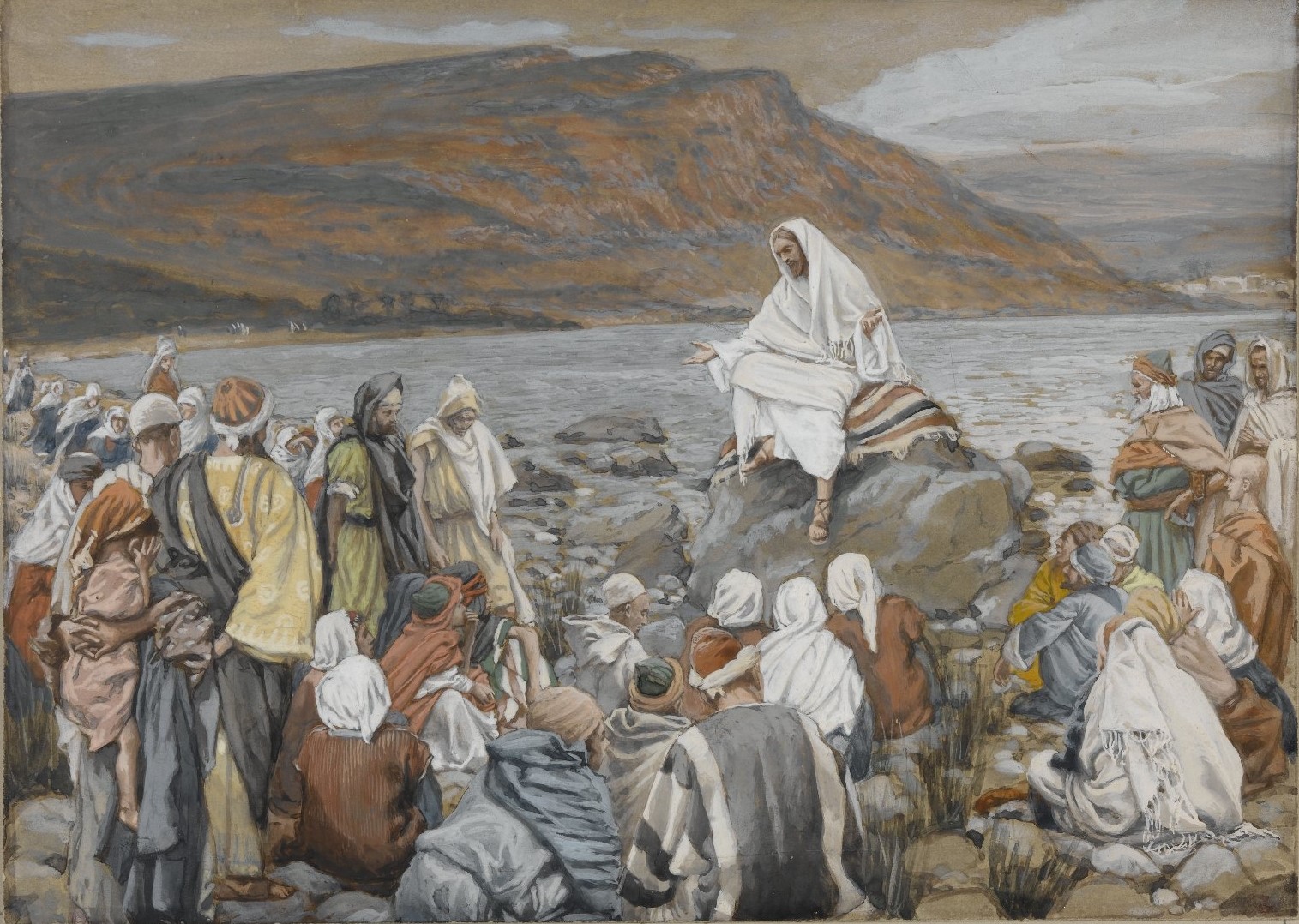
Matthew 13:16-17 [The Scriptures - TS]
16  “And blessed are your eyes because they see, and your ears because they hear,
17  for truly I say to you, that many prophets and righteous ones longed to see what you see, and did not see it, and to hear what you hear, and did not hear it.
[the words of Yeshua in purple]
No teacher in the history of humankind has been so repeated, copied and published than Yeshua of Nazareth. His stories are often called parables or illustrations. They not only have a moral lesson behind them, but in the case of some there are prophetic details. These prophecies embedded in Yeshua’s parables have already proved partially true, as history has established. Thus, those parts yet to be fulfilled can be approached with a high degree of confidence or conviction.
Perhaps of all the parables of the Messiah, those found in Matthew chapter 13 are among the most revealing. They reveal not only truths and moral principles, but also prophetic details that may well affect our lives today. What are these? How are Nazarenes (followers of Yeshua) or non-Nazarenes involved in these charming stories?
In this article, we attempt to discuss several parables that have a common thread – the Kingdom of the Messiah or the Kingdom of Heaven. These illustrations help us to understand how the King will judge his own Kingdom. They reveal what our own ultimate destiny will turn out to be. A strong associated theme regarding this Kingdom is that of judgement by the King himself. No Believer will escape this judgement, as Shaul (Paul) indicates:
2 Corinthians 5:10 [Hebraic Roots Bible - HRB]
For we all have to appear before the judgement seat of Messiah, in order for each one to receive according to what he has done in the body, whether good or evil.
With such a prospect in view, we approach these parables with keen personal interest.
MESSIAH’S OWN ASSEMBLY (CONGREGATION) WILL BE FILLED WITH WEEDS
Matthew 13:24-30 [TS]
24 Another parable He put before them, saying, “The reign of the heavens has become like a man who sowed good seed in his field,
25 but while men slept, his enemy came and sowed darnel (thisles) among the wheat and went away.
26 “And when the blade sprouted and bore fruit, then the darnel also appeared.
27 “And the servants of the master of the house came and said to him, ‘Master, did you not sow good seed in your field? From where then does it have the darnel?’
28 “And he said to them, ‘A man, an enemy did this.’ And the servants said to him, ‘Do you wish then, that we go and gather them up?’
29 “But he said, ‘No, lest while you gather up the darnel you also uproot the wheat with them.
30 ‘Let both grow together until the harvest, and at the time of harvest I shall say to the reapers, “First gather the darnel (tares) and bind them in bundles to burn them, but gather the wheat into my granary.” ’ ”
All the following parables have one single thing as their focus – the Kingdom. Not the seat of government, but the realm over which the King reigns: the realm of profession, the Assembly. Yeshua uses several parables to illustrate truths or mysteries about the Assembly he is to build. (Matthew 16:18; compare Ephesians 1:19-22).
The Greek word for ‘darnel’ or ‘nettle’ is «zizania» [Strong’s Exhaustive Concordance
# G2215, a kind of darnel, resembling wheat except the grains are black]
Yeshua says that ‘tares’, ‘thistles’ or ‘darnel’ have been planted among the wheat sown in his field. Generally, this plant (Lolium temulentum) is called either ‘tares’ or the ‘bearded darnel’ [King James Version and the James Moffatt Translation render it: ‘weeds’]. When it is young it resembles wheat but with maturity it turns black and stands up straight, while wheat is golden and bows its head.
William Barclay observes:
“The tares and the wheat are so like each other that the Jews called the tares bastard wheat. The Hebrew for tares is zunim, whence comes the Greek zizanion; zunim is said to be connected with the word zanah, which means ‘to commit fornication’ “.
The landlord or farmer is asked if these weeds should be uprooted or culled out. The landlord responds, “No, for accidentally while culling the «zizania» (tares) you may uproot the wheat also”.
What is the meaning of this parable? The disciples ask for an explanation. Yeshua gives added details when he explains the meaning of this kingdom comparison.
A JUDGEMENT OF THE MASTER’S FIELD
Matthew 13:36-43 [TS]
36 Then, having sent the crowds away, יהושע (Yehoshua) went into the house. And His taught ones came to Him, saying, “Explain to us the parable of the darnel of the field.”
37 And He answering, said to them, “He who is sowing the good seed is the Son of Adam,
38 and the field is the world. And the good seed, these are the sons of the reign, but the darnel are the sons of the wicked one,
39 and the enemy who sowed them is the devil (Ha Satan). And the harvest is the end of the age, and the reapers are the messengers.
40 “As the darnel, then, is gathered and burned in the fire, so it shall be at the end of this age.
41 “The Son of Adam shall send out His messengers, and they shall gather out of His reign all the stumbling-blocks, and those doing lawlessness,
42 and shall throw them into the furnace of fire – there shall be wailing and gnashing of teeth.
43 “Then the righteous shall shine forth as the sun in the reign of their Father. He who has ears to hear, let him he (shama)!
The Hebrew Gospels from Sepharad render verse 43 as
Matthew 13:43 [Hebrew Gospels Sepharad - HGS]
Whosoever has ears to hear, let him obey *(shama)
*The Hebrew word שָׁמַע (shama) has a dual meaning - it means to hear and act accordingly (obey.
The “Hebrew Gospels from Sepharad” refers to a small group of medieval Hebrew manuscripts—primarily the Vatican Library’s Vat. Ebr. 100—that preserve Hebrew versions of the four canonical Gospels as they circulated among Sephardic Jews in medieval Spain.
So, anyone who reads Yeshua’s parable’s explanation should listen with comprehension as well as a willingness to respond to the moral within the teaching and obey.
When asking for an interpretation to this Kingdom parable, it is the disciples who call it ‘the parable of the «zizania» of the field’. We see also the critical point they wondered about – should the wheat and weeds grow together?
IN YESHUA'S PARABLES:
THE FIELD IS THE WORLD
Yeshua first explains that the <field is the world>.
The Greek for ‘world’ is «kosmos» and means something arranged in a certain order to characterise it. The whole world is the field of the Eternal and of the Master Yeshua.
In that field the <good seed are the sons of the kingdom>. Yeshua used this phrase earlier in Matthew 8:12; 2 Timothy 2:19. These are children of Yisra’el, the children of Yahweh.
It is likely that Daniel 7:14 refers to this international mixture of ‘sons of the Kingdom’ who became subjects in Messiah’s kingdom – Daniel 7:13; Ephesians 1:19-21.
Daniel describes these subjects as coming from ‘peoples, ethnic groups and languages’. This is the same language that describes that reign of kings and priests at Revelation 5:9, 10; 7:9.
<Darnel> is another ‘seed’ sown in this field. These are ‘the sons of the Adversary [Ha-Satan]’. This distinction made by Yeshua is also in the writings of the book of John 8:44;
1 John 3:10. According to the author of the book of John what primarily identifies the children of the Adversary is hatred and lack of love manifest in charity. On this matter compare Matthew 25:31-46.
The enemy sowing the seed of evil is the Adversary (Ha-Satan). Shaul describes this when he writes to the Corinthians:
2 Corinthians 11:3-4, 14-15 [TS]
3 But I am afraid, lest, as the serpent deceived Hawwah (Eve) by his trickery, so your minds should be corrupted from the simplicity that is in Messiah.
4 For, indeed, if he who is coming proclaims another יהושע (Yehoshua), whom we have not proclaimed, or if you receive a different spirit which you have not received, or a different Good News which you have not accepted, you put up with it well enough!
. . .
14 And no wonder! For Satan himself masquerades as a messenger of light!
15 It is not surprising, then, if his servants also masquerade as servants of righteousness, whose end shall be according to their works!
Indeed, virtually every inspired epistle warns of these works of evil and lawlessness – which is apostasy – within the Followers of Messiah – 2 Thessalonians chapter 2; 1 Timothy 4:1-3; 2 Timothy chapter 3; 4:1-3; 2 Peter chapter 2; 1 John chapters 2-4; Jude. Yeshua foretold such lawlessness early in the ‘group of followers’ during the first few decades. He predicted that love would grow cold:
Matthew 24:12 [TS]
12 And because of the increase in lawlessness, the love of many shall become cold.
Years later, Shaul echoed this when he says:
2 Thessalonians 2:7
 For the mystery of lawlessness is already working . . .
And the author of the book of John declared:
1 John 2:18 [HRB]
Little children, it is a last hour, and as you heard that the anti-Messiah is coming, even now many anti-Messiahs have risen up, from which you know that it is a last hour.
But this growing together of the wheat and the weeds was not to last forever. The harvest time would come. Yeshua calls it ‘the consummation of a period of time.’ The whole phrase in Greek is: «te synteleia tou aionos».
It is nearly identical to Matthew 24:3 and Hebrews 9:26.
This phrase is also rendered:
the end of the world: King James Version
the conclusion of the age: Alexandria
End of the age: The Scriptures 2009, Hebraic Roots Bible
the consummation of the world: Douay-Rheims
the conclusion of this state: Living Oracles NT (1835)
It seems the disciples draw their use in Matthew 24:3 from Daniel 9:26 where «synteleias» occurs in the Jewish Greek Bible (The Septuagint – LXX).
This is an angelic harvest. The King Messiah uses his angels to assist in the harvesting of the wheat and weeds. Yeshua says the s