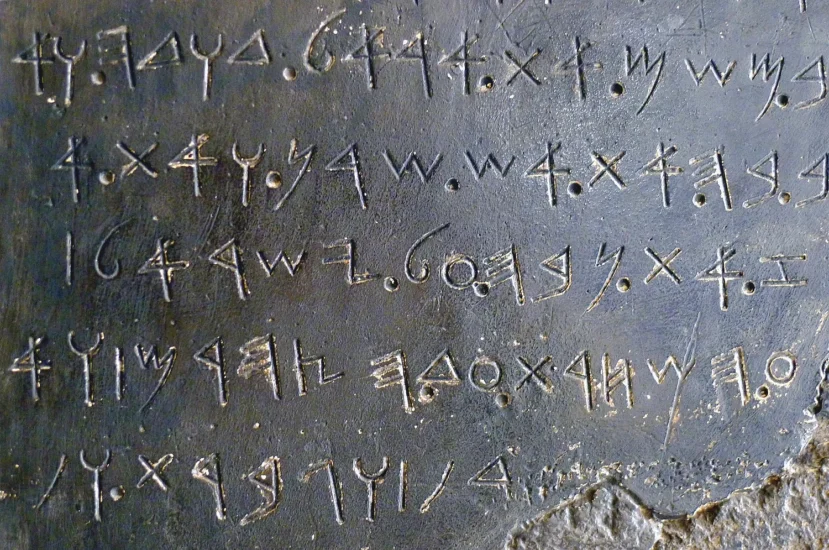
[See (THE MOAB STONE) THE MESHA STELE for more information]
A widowed mother instructed her young daughter-in-law, also a widow, to slip out at night to the threshing floor where a powerful man is sleeping and lie down at his feet. This is actually one of the most powerful pictures of redemption in the Scriptures. This young woman was a *Moabite. Why does that matter? Because Yisrael’s law was strict about her people:
Deuteronomy 23:3
An Ammonite or Moabite does not enter the assembly of יהוה (Yahweh), even a tenth generation . . .
*The dark origin of the Moabites is found in Genesis 19:
After Lot and his two daughters escaped the divine destruction of Sodom and Gomorrah . . . the oldest daughter convinced the younger daughter to join her in an incestuous relationship with their father to perpetuate the family lineage . . . Both daughters conceived sons by their father by getting him drunk. The son of the youngest daughter was named Ammon, father of the Ammonites. The son of the oldest daughter was named Moab, the father of the Moabites . . . The Moabites were a pagan nation, which means they did not worship or serve YHWH. Idolatry was one of the innate characteristics of all the nations surrounding Israel, and Chemosh was the national god of the Moabites (Numbers 21:29) . . . the Moabites were polytheistic (Judges 10:6), and through much of their history, they were hostile toward Israel.
Stephen Baker
PROPHETIC PRONOUNCEMENTS IN SCRIPTURE
Isaiah 15-16 – the prophet describes the devastation of Moab. The prophecy details the lamentation and morning of Moab as its cities are laid waste.
Jeremiah 48 – details the reasons for Moab’s downfall emphasizing the nations pride and idolatry. The chapter concludes with a promise of restoration.
Ezekiel 25:8-11 – addresses Moab’s scorn towards Judah.
Amos 2:1-3 – condemns Moab for its violent acts.
The judgement of Moab serves as a reminder of the Eternal’s justice and the consequences of pride, idolatry, and hostility towards his people.
Bible Hub – Judgement of Moab
So how can a woman from an excluded people end up married to a hero of Yisrael and become the great-grandmother of King Dawid (David) and an ancestor of the Messiah?
This is the story of Ruth. A young widow, an immigrant from a people deemed an enemy. She arrived in a foreign land with her mother-in-law Naomi, who had also lost everything. They had no money, no social standing, no future. In that culture, being a widow without children was a sentence to poverty and oblivion. Their only hope of not starving was for Ruth to go into the fields and glean the stalks the reapers drop. A humble task reserved for the destitute. Providence led her to the field of a good and wealthy man named Boaz. To her surprise, he treated her with extraordinary kindness. He protected her, made sure she had water to drink and plenty of food. But then, Naomi gave Ruth an instruction that sounds both strange and dangerous:
Ruth 3:3-4
3 "And, you shall bathe and anoint yourself, and put your garments on and go down to the threshing-floor. Do not make yourself known to the man until he has finished eating and drinking".
4 "And it shall be, when he lies down, that you shall notice the place where he lies, and shall go in and uncover his feet, and lie down. And let him make known to you what you should do".
RUTH WAS NOT SEDUCING BOAZ
SHE WAS INVOKING AN ANCIENT LEGAL RIGHT
This action is risky and could easily be misunderstood in the worst possible way. This does not read like a conventional love story. It sounds like a desperate plan. What Ruth did was not an act of seduction.
In Scripture, particularly in the context of the book of Ruth, “to uncover someone’s feet” refers to a symbolic act of seeking protection and marriage. Ruth’s action of uncovering Boaz’s feet was a way of expressing her desire for him to take her under his care as a kinsman-redeemer.
goodquestionblog.com; splnewulm.org
It was a legal appeal, a deep and powerful cultural claim. By uncovering Boaz’s feet and lying down under the edge of his cloak, Ruth was symbolically saying that she was unprotected and defenceless. She was asking to be covered by his protection and to be redeemed:
Ruth 3:9
. . . Now you shall spread your covering over your female servant – for you are a redeemer.
She was invoking one of Yisrael most fascinating laws, the law of the kinsman redeemer (Hebrew: gaol): Leviticus 25. And here is the key that brings everything into focus:
In ancient Yisrael, if a family lost its land or was forced into slavery because of debts,
not just anyone could step in to rescue them.
The kinsman redeemer law set two very strict conditions for one who would redeem:
1) He had to have the price. He needed to be wealthy enough to pay the debt.
2) He had to be a blood relative, a member of the same family.
A generous rich person might give a handout out of compassion, but he could not legally redeem the inheritance or restore your lineage. Only a brother, an uncle, a cousin had the right and that obligation. Boaz grasped the gesture instantly. He did not see it as something immoral, but as an act of deep family loyalty:
Ruth 3:10
. . . And he said, “Blessed are you of יהוה, my daughter! For you have shown more kindness at the end than at the beginning, not to go after young men, whether poor or rich.
Boaz saw that Ruth was not chasing a personal whim, but the restoration of her fallen family. However, there was another relative closer than Boaz. The plan could fall apart. The next day, Boaz went to the city gate, the place where legal transactions were finalized. He called that other relative and in the presence of the elders, offered him the chance to redeem Naomi’s land. The man agreed at once until Boaz added the crucial condition. The day he buys the field he must also take Ruth the Moabitess to preserve the name of the deceased upon his inheritance. Hearing this, the other kinsman backed out. He did not want to entangle his own inheritance with a foreigner. So, in a public act, he slipped off a sandal and handed it to Boaz. That gesture was the equivalent of signing before a notary, an unbreakable public seal. Boaz then redeemed the land and took Ruth as his wife. Why do the Scriptures spend so much time on legal details about kinsmen and sandals? What does this ancient custom have to do with us today?
This is where this Old Testament love story bursts into theological truth that changes everything. Humanity was in the same position as Ruth. We were outsiders with no claim in the Kingdom of the Eternal. We were in debt because of sin, spiritually bankrupt with no way out. Likewise, we needed a redeemer from heaven. The Eternal had the power and the wealth to pay our debt. He owns it all. But there was a legal issue in the court of the universe. The Eternal was not our blood relative. The Eternal is spirit; we are flesh and blood. He was not part of our family. Under the strict law of the «gaol», the kinsman redeemer, an outsider could not carry out the redemption. To be our redeemer, he could not be an angel or some far-off celestial being. The Redeemer had to be one of us, our kin and that is what Yeshua was.
The book of Hebrews says:
Hebrews 2:14-17
14 Therefore, since the children share in flesh and blood, He Himself similarly shared in the same, so that by means of His death He might destroy him having the power of death, that is, the devil,
15 and deliver those who throughout life were held in slavery by fear of death.
16 For, doubtless, He does not take hold of messengers, but He does take hold of the seed of Abraham.
17 So in every way He had to be made like His brothers, in order to become a compassionate and trustworthy High Priest in matters related to Elohim, to make atonement for the sins of the people.
The Messiah had our blood. It was a legal requirement of heaven. Yeshua was born a human, carried human DNA, and bled human blood so that he could become legitimately our kinsman redeemer. The Messiah became our ‘Boaz’.
He had the infinite price to pay our debt, his perfect sinless life. Yeshua was our kin. He was a man, so he had the legal right to sign the papers for our freedom. And unlike the other relative in the story, Yeshua was willing to pay the full price no matter the cost. He redeemed us not with gold or silver, but with his life.
A MOABITESS
BECAME A DIRECT ANCESTOR OF THE MESSIAH
Ruth’s has one final twist that ties the circle perfectly. Ruth, the rejected Moabitess, a foreigner from an enemy people once redeemed by Boaz, bore a son named Obed who is the father of Jesse, and Jesse is the father of King David. The rescued foreigner became the great-grandmother of Yisrael’s greatest king and a direct ancestor of Yeshua the Messiah himself. The Eternal used a love in a barley field to teach us the deepest theology. The redeemer had to be one of us with the purpose to buy us back and bring us home.
Source:
Transcript of a portion of The Secret that Connects the Entire Bible (The Power of the Word).
Bible Hub; goodquestionblog.com; splnewulm.org
Edited: Nazarene Notes
Unless otherwise noted,
all Scripture verses were taken from The Scriptures
Copyright by Institute for Scripture Research.
Used by permission.