The name of the Messiah is Yehoshua (יהושע), which translates to "Yah is salvation."
This website uses the short form "Yeshua" to represent this name.
Mark 15:34 [The Scriptures 2009 - TS 2009]
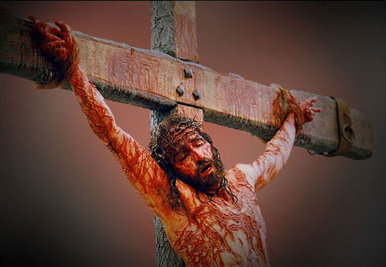
34  And at the ninth hour יהושע (Yeshoshua) cried out with a loud voice, saying, "Eli, Eli, lamah shebaqtani?” which is translated, “My El (God), My El, why have You forsaken Me?”
(Words of Yeshua in purple)
On the surface, it sounds like Yeshua is cracking, a man in his final moments crying out to his Father, who is not there to help him. Yeshua was not questioning the Eternal. He was quoting from Scripture, and the passage he was pointing to does not end in despair. It actually ends in one of the most triumphant declarations in the entire Old Testament.
When we understand what a first century rabbi was actually doing when he spoke these words from the execution stake, we do not see a defeated man being destroyed. We see a conquering King who is in complete control of the situation, still teaching in the worst moments of his life. Yeshua was pointing his disciples to the plan the Eternal has been writing for centuries before.
EVEN AT THE MOMENT OF HIS DEATH
YESHUA WAS TEACHING FROM THE SCRIPTURES,
POINTING TO THE ETERNAL'S PLAN
Most people skip the language that Yeshua used when he was crying out from the cross. Matthew 27:46 is the only statement from the execution stake that is recorded in Hebrew or possibly Aramaic, the common language that was spoken during that time by everyone in Galilee or Judea. Aramaic was the common language of the people; however, Hebrew was considered to be the sacred language, the language of the rabbis, the language of the Temples, and of the Scriptures. Most people standing at the execution stake that day, unfortunately, would not have understood Yeshua when he said this. In fact, as we study the text, the Roman soldiers thought Yeshua was crying out for Elijah, when he cried out “Eli, Eli. . .” But he was not calling for Elijah. He was calling their attention to Scripture.
In the first century, rabbis did not preach the way teachers do today. They did not have the Scriptures divided in chapters and verses (this was devised in the 16th century after Yeshua). Back then, they simply quoted the first line of a particular section of Scripture, and it would draw the attention of their audience to the text that began the section. For example, if someone were to say ‘Our Father who art in heaven . . . we would immediately know what follows. The ancient audience was able to do the same because they knew the word of the Eternal. They hid it in their hearts.
Matthew 27:46; Mark 15:34 [TS 2009]
. . . יהושע cried out with a loud voice, saying, "Eli, Eli, lemah shebaqtani?” that is, “My El, My El, why have You forsaken Me?”
He is actually quoting the opening line of Psalm 22. He was not surrendering to the Roman army. Furthermore, he was communicating to his disciples, even from the stake, when he is gasping for breaths of air. Yeshua was still pointing his followers to a specific passage of Scripture. When we read Psalm 22 through that lens, it changes everything. It is a prophetic Psalm written by Dawid (David) and part of a collection of three Messianic Psalms:
• Psalm 22 is a picture of the Messiah as a suffering servant.
• Psalm 23 is a picture of the Messiah as a shepherd.
• Psalm 24 is a picture of the Messiah as the King or Ruler.
Yeshua fulfils all these roles.
Psalm 22 is a prophetic poem by David that goes into very graphic, almost uncomfortable detail about how the Messiah would suffer.
Psalm 22 describes Yeshua’s crucifixion; however, it was written by King Dawid roughly a thousand years earlier and 400 years before crucifixion was even used by the Romans. The Persians were using it 600 years before Yeshua and the Romans perfected it into the method used on Yeshua.
Verse 7: All those who see Me mock Me; They shoot out the lip; they shake the head . . .
Describes the suffering of the coming Messiah in graphic almost uncomfortable detail.
Verse 15: My strength is dried like a potsherd, And My tongue is cleaving to My jaws; And to the dust of death, You are appointing Me.
Here we have a picture of the Romans and the religious leaders trying to attack Yeshua.
Verse 16: For dogs have surrounded Me; A crowd of evil ones have encircled Me, Piercing My hands and My feet
In Scripture, anytime you see a reference to an animal, a bull, a dog, or a pig, it is almost always synonymous with the Gentiles. Here we have the Gentiles attacking him. They pierced his hands and feet.
Verse 17: I count all My bones. They look, they stare at Me.
We know that they did not break his bones, that he died naturally, and at the end they speared him in the side to make sure that he had died.
Verse 18: They divide My garments among them, And for My raiment they cast lots.
His bones were out of joint. His heart was melting like wax; his tongue was stuck to the roof of his mouth. The crowds were mocking him . . .
Let us stop at verse 6 because many people will read Psalm 22 and will go right past this verse:
Verse 6: But I am a worm, and no man; A reproach of men, despised by the people.
The Hebrew word used here is «tola’ath», a word for a tiny insect, worm, or grub. However, it also means something else. In ancient times, to produce a dye they crushed the «tola’ath» worm to produce a crimson or scarlet colour. In the Hebrew dictionary, the word «tola’ath» is translated as crimson or scarlet. (Please read the article: THE CRIMSON OR SCARLET WORM; also read MESSIAH’S DEATH FORETOLD)
The word «tola’ath» is used throughout Scripture; we see it in:
Exodus 26:1: The Eternal instructs Moses to sew into the curtains of the Tabernacle colours of blue, and purple and scarlet («tola’ath»).
2 Chronicles 3:14: The Eternal instructs Solomon to sew, into the veil that separates the Holy of Holies and the Holy place, colours of blue and purple and crimson («tola’ath»).
Joshua 2: Rahab is instructed to take a crimson («tola’ath») cord and put it out of her window to be spared along with her family when Yisra’el decimated the entire city. Anybody under the house that had the scarlet cord would be saved.
The Jewish audience at the cross who heard Yeshua’s words realized that was a callback to the Exodus when the Eternal told them to do something similar. They were to take the blood (crimson colour) of the innocent lamb, and apply it to the doorposts of their homes, so that when the angel of death would pass by, they would be spared.
Matthew 27:27-30 [TS 2009]
27 Then the soldiers of the governor took יהושע into the court and gathered the entire company of soldiers around Him.
28  And having stripped Him, they put a scarlet robe on Him.
29  And plaiting a crown of thorns, they put it on His head, and a reed in His right hand. And they kneeled down before Him and mocked Him, saying, “Greetings, Sovereign of the Yehudim!”
30  And spitting on Him they took the reed and struck Him on the head.
The colour of the robe they put on him was scarlet (red, crimson). The Eternal gave us a picture. Yeshua is not just any man who was going to die at the stake. He took the transgressions of mankind, the scarlet robe as a picture on his back, so that you and I do not have to.
The Eternal said in Isaiah:
Isaiah 1:18 [TS 2009]
Though your sins are like scarlet, they shall be as white as snow; though they are red like crimson, they shall be as wool.
(Words of the Eternal in blue)
Crimson throughout Scripture is always associated with sin. So, when king Dawid wrote in Psalm 22 that the Messiah would be like a worm («tola’ath»), crushed to produce crimson, he is prophesying something breathtaking. Yeshua, at the stake, was crushed like a worm. He was pressed down, his life poured out like pigment. Paul tells us in 2 Corinthians that the Eternal made him who knew no sin to become sin for us, that we may become the righteousness of the Eternal. Yeshua not only died, but he also absorbed our sin.
Psalm 22 begins in a bad way. My El, my El, why have you forsaken me? Why have you turned against me? Why are people attacking me? Why are people criticizing me? If you stop at the beginning section, you will think we are hopeless, helpless. But that is not how the Psalm ends. By the time you get to the final verses, the tone in the Psalm completely shifts, the structure is fascinating.
Psalm 22:27-31 [Hebraic Roots Bible - HRB]
27 All the ends of the earth shall remember and turn back to YAHWEH; and all the families of the nations shall worship before You.
28 For the kingdom belongs to YAHWEH; and He is the ruler among the nations.
29 All the fat ones of the earth have eaten, and have worshiped; all those going down to the dust shall bow before Him; and He kept not His own soul alive.
30 A seed shall serve Him; it shall be spoken of YAHWEH to the coming generation.
31 they shall come and shall declare His righteousness to a people that shall yet be born; for He has done it.
The scholar Richard Hayes says that this Psalm is a picture of what happened to Yeshua at the stake. When Yeshua quotes the opening words of Psalm 22, he is pointing us to the entire Psalm, including the triumphant conclusion. Yeshua is not saying we are losing. He is saying it looks bad, but we will win in the end. Not despite the suffering, but through it. The agony in verse 1 leads to the road to victory in verse 31. Even in the moment of darkness, Yeshua was not without hope. He was not a man drowning with no one coming. He was the Son of the Eternal, fully aware of what his death would accomplish. Furthermore, he is calling his followers, you and me, to see that. When we read verse 1 without knowing the context, it sounds like the Eternal is abandoning His son at the worst possible moment, when he needs Him most. Yeshua quoted Psalm 22 in full. The Eternal did not abandon His son on the stake. He was there with him the entire time. The plan that He inspired to be written a thousand years before was being carried out. The forsaking that Yeshua experienced, the full weight of divine judgement upon his back for human sin, he took so that you and I do not have to. The Eternal’s divine presence is present during your most challenging moments. The «tola’ath» worm was crushed. The crimson was poured out. The sin was stained with scarlet. It was transferred onto him.
Psalm 22 promises that the nations will remember. The next generation will talk about this. People who are not yet born will declare it, and we are the beneficiaries of that promise. The agony of the cross was not the end of the story. It was the beginning of our story.
Yeshua spent his final hours being betrayed, denied, rejected, mocked and even condemned. And yet as he hung dying on that stake, he was still a rabbi, still teaching, still pointing his disciples to the Scriptures to show them nothing happens outside the plan of the Eternal. He quoted Psalm 22 not as a man losing hope, but as a man who knew exactly how the story would end.
The five words from the first verse of the Psalm are not words of despair. This first verse is one of the greatest declarations of faith and victory in all Scripture, if it is interpreted correctly.
Source:
Roby Gallaty (Get into the Word)